

How to be a good leader and manage people successfully
How to develop, market, and sell your products and services
How to use connections and partnerships to create your own network
How to promote and maintain the company’s positive image
How to gather, interpret and create reports based on industry data
How to hire top talent and improve employee retention
2.10 Entry Requirements/Qualification:
2.10.1 Direct Entry Requirements/Qualification: (Must be precise and clear, should describe minimum points/grades/GPA as the case may be)
A holder of Bachelor degree in Electrical Engineering and/or Electronic engineering, or Electronics and Instrumentation engineering, or Control Engineering, or Power Engineering, from a recognized University or Institution of Higher learning having at least a minimum GPA of 2.7 or B grade.
2.10.2 Equivalent Entry Qualification: To be eligible for admission into this programme, the student should satisfy
S/N Category of Applicants Minimum admission entry qualifications
Equivalent applicants Postgraduate Diploma in Electrical and/or Electronics Engineering, or Electronics and Instrumentation Engineering, or Control Engineering, or Power Engineering with At least a GPA of 3.0 or B grade
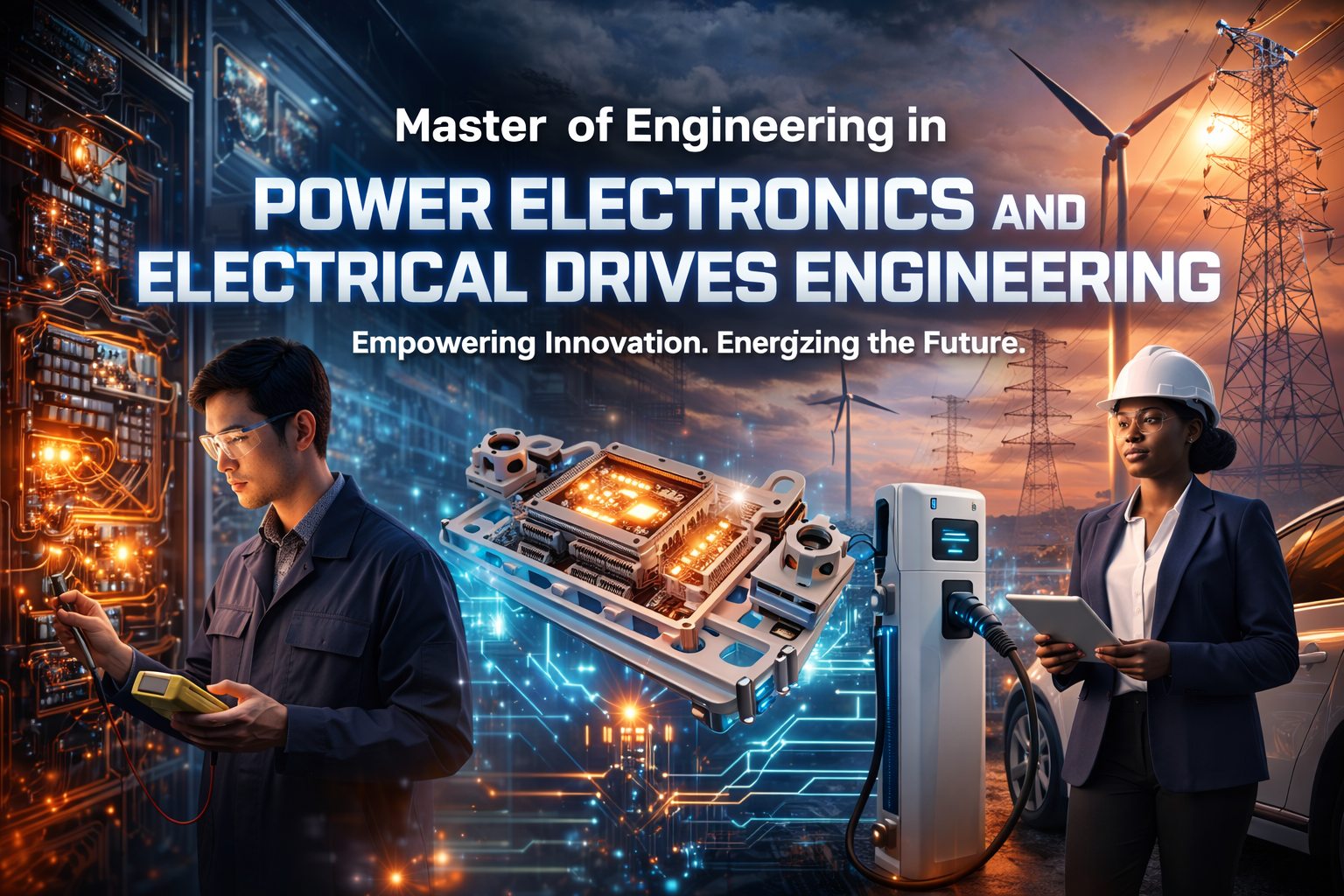
The Master of Engineering in Power Electronics and Electrical Drives Engineering is an advanced program focused on the design, control, and application of modern electrical energy systems and drive technologies. The program integrates power electronics, electrical machines, control systems, and energy conversion technologies to meet the growing demand for efficient and sustainable energy solutions.
Students gain both theoretical knowledge and practical experience in developing high-efficiency power converters, motor drive systems, and renewable energy applications. The program emphasizes hands-on training, simulation, and real-world projects using modern tools and technologies. Graduates are equipped to work in industries such as renewable energy, electric vehicles, power systems, industrial automation, and smart grid technologies, as well as in research and development roles.
Design & Development
Practical Engineering Skills
Energy & Sustainability
Digital & Embedded Applications
Analytical Thinking

Education is the foundation of all we do in life. It shapes who we are and what we aspire to be.



.png)



 SJCHAS - JOB Vacancy Announcements